
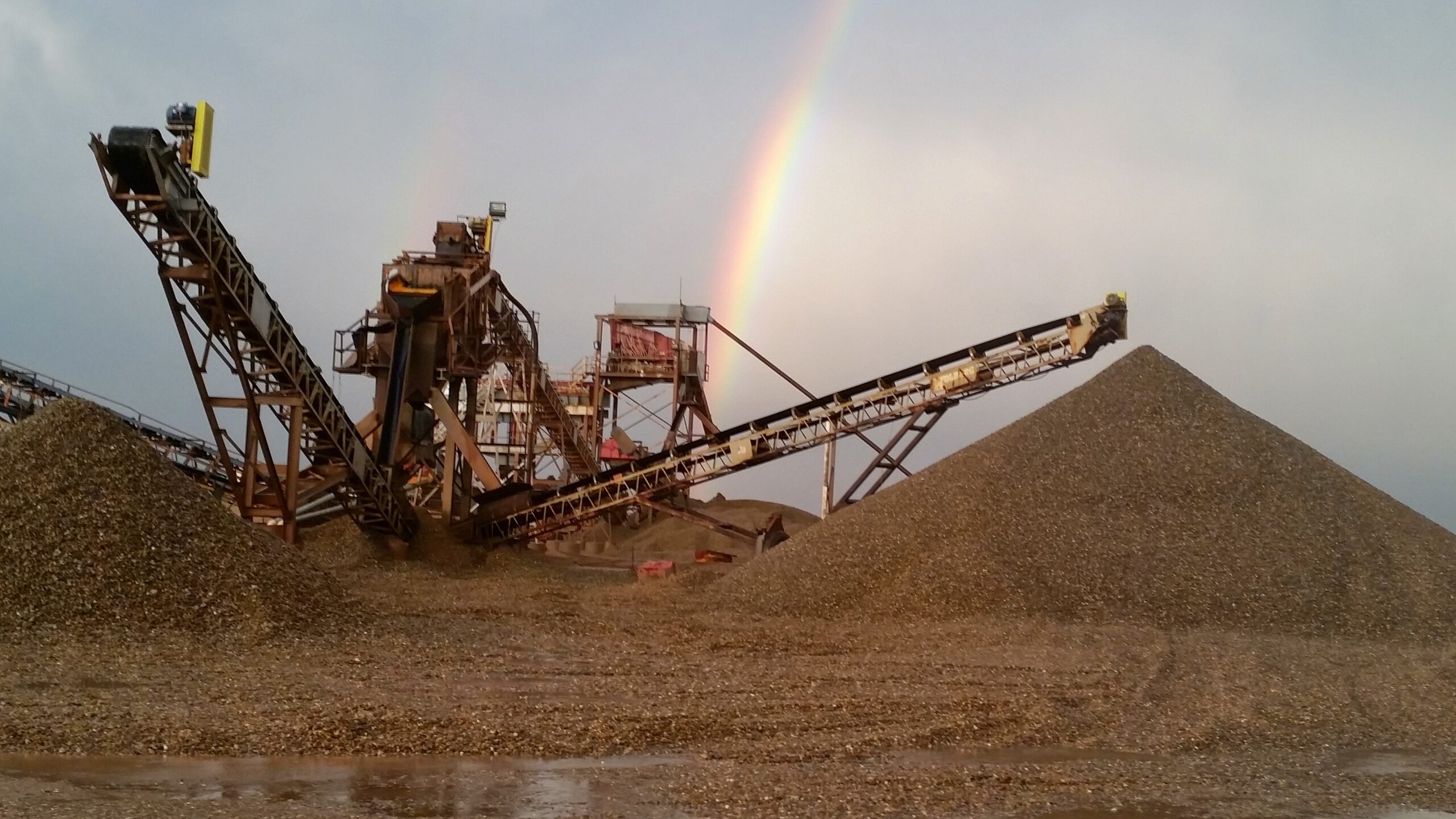
One of the most common misunderstandings in the aggregate industry is the assumption that in-place reserves are worth a substantial portion of the sales price of the finished aggregate material. In real-world discussions involving landowners, investors, buyers, and operators—particularly during acquisition and due diligence evaluations—it is not unusual for stakeholders to assume that reserves in the ground may be worth 50 to 75 percent of the eventual sales price per ton. From an educational and economic standpoint, this expectation is typically much higher than the actual value of the aggregate in the ground once costs, time, operational factors, and risk are properly considered.
Executive Summary
Aggregate reserves in the ground do not represent finished, marketable product and should not be interpreted as a large portion of the eventual sales price per ton. The sales price reflects processed material delivered to market after permitting, extraction, processing, transportation, capital recovery, and operational risk over time. When realistic economic factors such as operating costs, production timelines, and discounted cash flow are considered, the in-place value of aggregate is typically only a fraction of the final sales price of the finished material.
Understanding the Common Industry Misconception
Across the industry, a frequent assumption is that if aggregate sells for a certain price per ton, then the material in the ground must be worth a large percentage of that same price. This perspective is understandable at a surface level but does not reflect how aggregate resources are actually developed and monetized. The material in the ground is not immediately saleable and must go through multiple stages before it becomes revenue-generating product.
Before any aggregate is sold, the deposit must be permitted, accessed, stripped, excavated, processed, managed, and marketed over an extended operational period. Each of these stages introduces real costs, time considerations, and operational risks that significantly influence the economic value of the reserves.
Gross Revenue Compared to Real Economic Value
The sales price per ton represents gross revenue at the point of sale, not profit and not present economic value. Between the reserve in the ground and the final saleable product, there are substantial costs that must be incurred, including overburden removal, excavation, processing, equipment, labor, fuel, maintenance, regulatory compliance, site development, and ongoing capital expenditures.
When these real-world factors are incorporated into a realistic evaluation, the economic value of the reserves is significantly lower than simple gross revenue calculations based solely on tonnage multiplied by sales price.
The Role of Time and Discounted Cash Flow
Another important educational consideration in aggregate valuation is time. Aggregate deposits are developed over years or decades depending on market demand, production rates, and operational capacity. Revenue is not realized immediately but is generated gradually over the life of the operation.
Discounted cash flow analysis reflects this reality. Future income is worth less than immediate income due to operational risk, market uncertainty, capital exposure, and the time required to extract and sell the reserves. When future revenues are properly discounted to present value, the resulting in-place valuation is typically only a fraction of the theoretical gross sales value.
Royalty Value Compared to Operator Value
It is also important to distinguish between royalty value and operator value. A landowner receiving a royalty per ton is not responsible for capital investment, operational costs, permitting, equipment, or market risk. Therefore, royalty-based valuations are typically derived from projected production and discounted future royalty income rather than the gross sales price of the finished aggregate.
An operator, by contrast, must account for plant investment, site development, infrastructure, regulatory compliance, equipment costs, and ongoing operational risks. These responsibilities further demonstrate why in-place reserves cannot reasonably be equated to a large portion of the sales price of the finished material.
Real-World Factors That Influence In-Place Aggregate Value
Several practical factors consistently influence the economic value of aggregate deposits, including stripping ratios, processing requirements, water management, access limitations, haul distance to market, permitting timelines, environmental considerations, and regional competition. Market demand, fuel costs, equipment wear, and regulatory conditions also affect long-term project economics and must be considered in any realistic evaluation.
Capital Investment and Operational Reality
Aggregate operations require substantial upfront capital investment before sustained production begins. Site preparation, plant installation, equipment acquisition, permitting, and infrastructure development all occur prior to meaningful revenue generation. These capital requirements must be recovered over the operational life of the deposit, further reducing the present economic value of the reserves when compared to theoretical sales price assumptions.
Additionally, production rates are constrained by market demand, plant capacity, logistics, and operational efficiency, meaning reserves are monetized gradually rather than immediately.
Educational Perspective on Professional Valuation Approaches
From an educational standpoint, professional evaluation of aggregate deposits typically considers discounted cash flow analysis, royalty income modeling, operational feasibility, and market conditions rather than relying on simple tonnage multiplied by sales price. These approaches provide a more realistic understanding of economic value and align with how aggregate resources are evaluated in acquisitions, due diligence, and project planning.
Conclusion: Educational Understanding of Fractional In-Place Value
In-place aggregate reserves should be viewed as having an economic value that represents only a fraction of the eventual sales price of the finished material. While it is common in preliminary discussions for stakeholders to assume values in the range of 50 to 75 percent of the sales price per ton, real-world economic analysis typically results in significantly lower in-place valuations once extraction costs, capital recovery, operational risk, market constraints, and discounted cash flow over time are properly considered. Developing a clear educational understanding of this distinction helps landowners, investors, buyers, attorneys, and operators form more realistic expectations regarding aggregate deposit value.
For a broader educational discussion on valuation methodology prior to acquisitions, see our related article on how to properly value an aggregate deposit before acquisition.